English
  한국어
한국어  Deutsch
  Español
  العربية
  русский
×
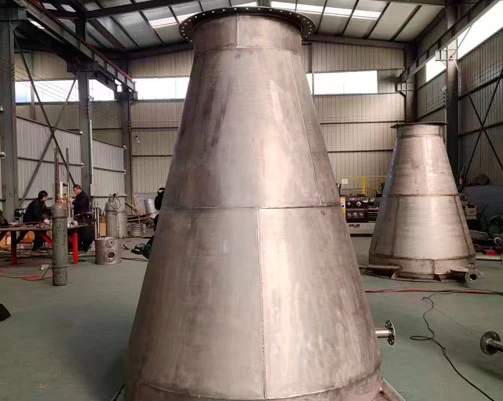
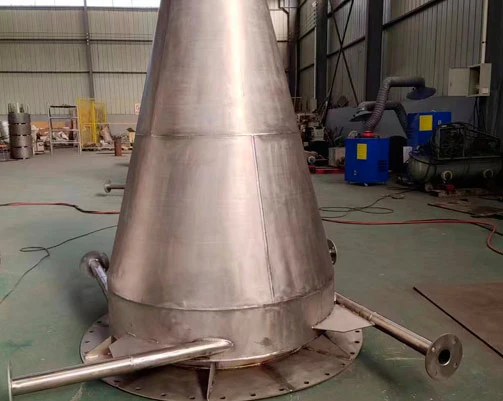
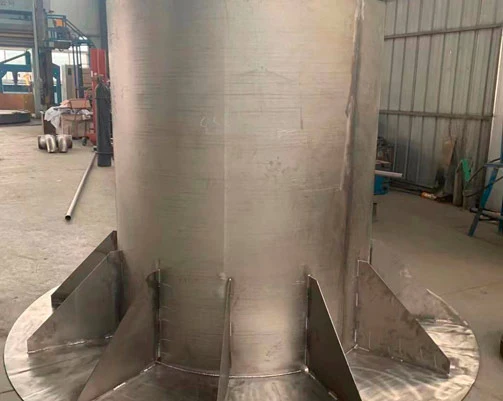
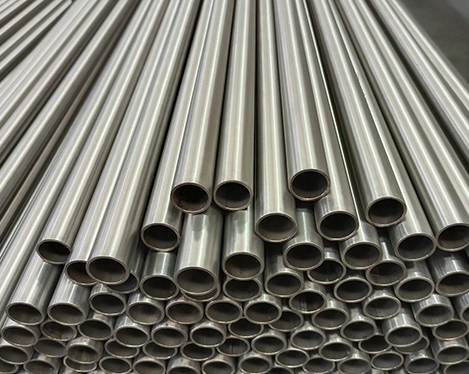
Titanium material is excellent in corrosion resistance, especially the Titanium-pladium Alloy Gr7, it is excellent corrosion resistance in the solution of HCl, H2SO4 and H3PO4.
In the acid regeneration process of steel mills, Titanium venturi serves as a pre concentrator, pump the waste acid from the pickling unit to the top of the titanium venturi for spraying.
The Titanium Acid Regeneration System is designed for hydrochloric acid regeneration processes in steel pickling plants. The system utilizes waste heat from the roasting furnace exhaust gas to concentrate spent hydrochloric acid and recover valuable acid resources while producing iron oxide (Fe₂O₃) by-products.
The complete system consists of:
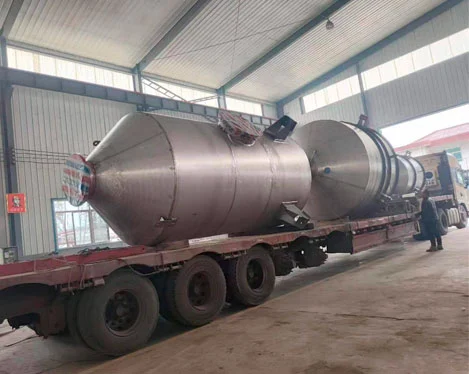
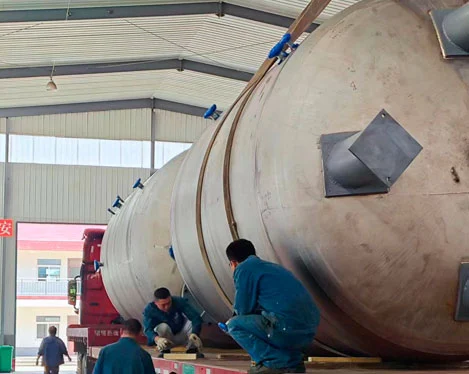
Titanium Venturi Pre-Concentrator
Titanium Spray Lance Assembly
Titanium Dust Collector / Separator
Acid Recovery & Gas Treatment Components
Manufactured primarily from Titanium-Palladium Alloy Grade 7 (Ti-Pd Gr7), the system offers exceptional corrosion resistance, high-temperature stability, and long service life under highly aggressive hydrochloric acid environments.
Spent acid from the steel pickling line enters the Titanium Venturi Pre-Concentrator.
Using direct contact heat exchange with high-temperature furnace exhaust gas, water is evaporated from the waste acid, increasing acid concentration before entering the roasting furnace.
The concentrated acid is delivered through the Titanium Spray Lance and atomized into the roasting furnace.
Fine droplet atomization maximizes heat transfer efficiency and promotes complete thermal decomposition.
Inside the roasting furnace:
FeCl₂ and FeCl₃ are thermally decomposed into:
Hydrochloric Acid (HCl)
Iron Oxide (Fe₂O₃)
Recovered acid is recycled back to the pickling process.
The Titanium Dust Collector separates iron oxide particles from the process gas stream.
The integrated scrubbing section removes:
HCl mist
Fe₂O₃ particles
Acid aerosols
ensuring compliance with environmental emission requirements.
The Venturi acts as a waste acid concentrator using the sensible heat of roasting furnace exhaust gases.
| Parameter | Value |
|---|---|
| Diameter | 700 mm |
| Height | 610 mm |
| Housing Material | Titanium Grade 7 |
| Immersion Tube Material | Titanium Grade 7 |
| Operating Medium | Pickling Waste Acid |
| Gas Temperature Inlet | 380 – 460°C |
| Gas Temperature Outlet | 83 – 95°C |
| Acid Temperature | 95 – 100°C |
| Component | Concentration |
|---|---|
| HCl | 50 – 170 g/L |
| FeCl₂ | 350 – 410 g/L |
| FeCl₃ | 30 – 70 g/L |
Direct heat recovery
Efficient acid concentration
Compact structure
Stable operation
Easy maintenance
Long service life
The spray lance atomizes concentrated waste acid into the roasting furnace for thermal decomposition.
| Parameter | Value |
|---|---|
| Nozzle Tube Length | 3170 mm |
| Nozzle Tube Diameter | Ø33 / Ø52 mm |
| Operating Pressure | 460 – 500 kPa |
| Hose Size | DN25 × 2600 mm |
| Nozzle Plate Diameter | Ø152 mm |
| Flow Rate | 3.5 L/min |
| Number of Nozzles | 11 – 13 |
| Plug Quantity | 2 – 3 |
| Component | Material |
|---|---|
| Nozzle Tube | Ti-Pd Gr7 / Niobium |
| Nozzle Plate | Ti-Pd Gr7 / Niobium |
| Filter Holder | Ti-Pd Gr7 / Niobium |
| Hose | PTFE + Stainless Steel Reinforcement + EPDM |
Uniform atomization
Excellent wear resistance
Corrosion-resistant construction
High operational reliability
The dust collector separates iron oxide particles generated during acid regeneration and returns them to the process.
The unit also functions as a wet scrubber for removing residual HCl and Fe₂O₃ from exhaust gases.
| Parameter | Value |
|---|---|
| Gas Velocity | 15 – 20 m/s |
| Separation Efficiency | 50% |
| Structure | Integrated One-Piece Design |
| Material | Titanium Grade 7 |
Iron oxide recovery
Flue gas cleaning
Acid mist removal
Emission control
Titanium Grade 7 contains palladium, significantly enhancing corrosion resistance in reducing acid environments.
Excellent resistance to:
Hydrochloric Acid (HCl)
Sulfuric Acid (H₂SO₄)
Phosphoric Acid (H₃PO₄)
Chloride-containing media
Suitable for continuous operation under elevated temperatures.
Reduced maintenance and replacement costs.
Compared with nickel alloys and stainless steels, titanium provides excellent strength-to-weight performance.
Reduces hydrochloric acid consumption through recycling.
Recovers waste heat from furnace exhaust gases.
Produces valuable Fe₂O₃ by-products.
Reduces emissions and wastewater discharge.
Minimizes chemical consumption and waste disposal costs.
Titanium construction ensures stable operation in highly corrosive environments.
Carbon steel pickling lines
Cold rolling mills
Hot-dip galvanizing facilities
Hydrochloric acid regeneration
Waste acid recycling systems
Steel processing
Metal surface treatment
We provide customized acid regeneration equipment according to process requirements.
Available options include:
Titanium Venturi size customization
Spray lance configuration
Dust collector capacity
Titanium Grade 7 or Niobium construction
Integrated acid recovery systems
Turnkey acid regeneration solutions

No.26 Baotai Road, Weibin District, Baoji City, Shaanxi, China.
No.26 Baotai Road, Weibin District, Baoji City, Shaanxi, China.