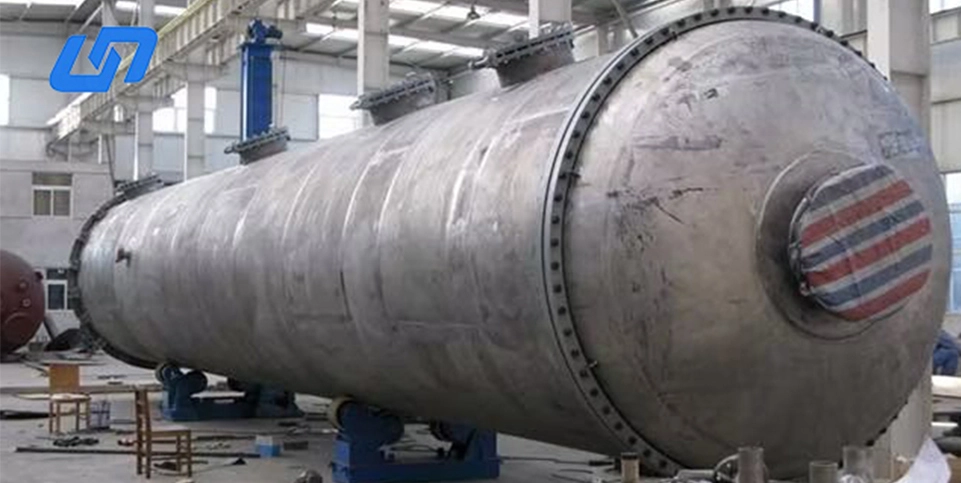
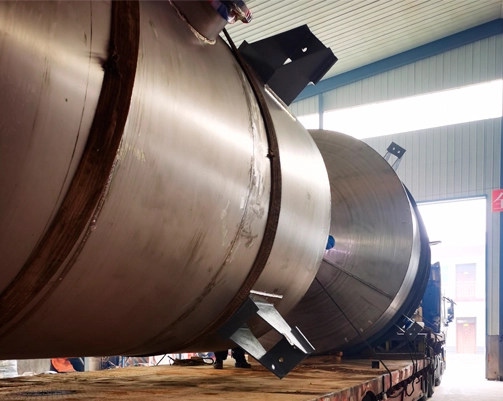
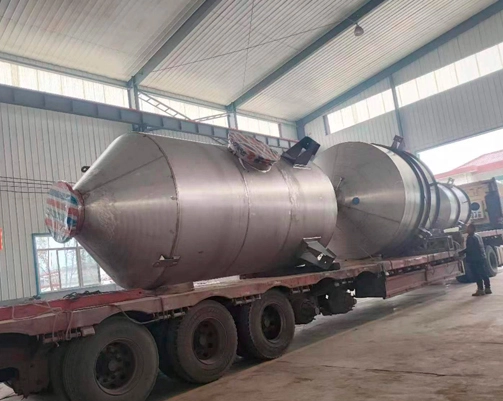
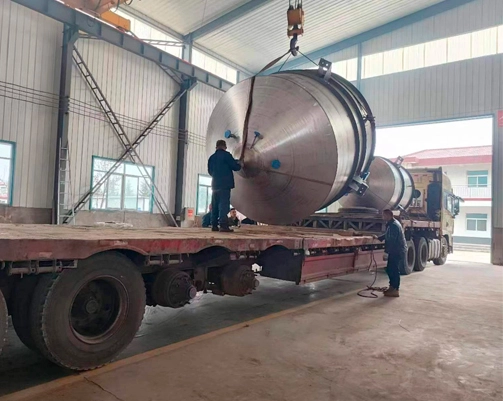
A falling film evaporator is a highly efficient evaporation system widely used for concentrating solutions, recovering solvents, and treating industrial wastewater.
The system is particularly suitable for heat-sensitive materials because evaporation takes place under vacuum and the liquid has a very short residence time on the heating surface. This helps reduce thermal degradation while maintaining high evaporation efficiency.
During operation, the feed liquid enters the upper distribution section of the evaporator and is evenly distributed onto the inner surface of the heat exchange tubes. Under the combined effect of gravity and vacuum, the liquid flows downward as a thin and uniform film.
Heat supplied from the shell side causes the liquid film to evaporate continuously. The generated vapor and concentrated liquid enter the vapor-liquid separation chamber, where they are separated. The vapor can be condensed or used as the heating medium for the next effect in a multi-effect evaporation system.
Falling film evaporators are widely used in pharmaceutical, food processing, chemical, environmental protection, and industrial wastewater treatment applications.
The falling film evaporation process typically follows these steps:
Feed Liquid → Liquid Distribution → Thin Film Formation → Heat Transfer → Evaporation → Vapor-Liquid Separation → Concentrated Product
The feed liquid enters the top distribution system and is evenly distributed across the heat exchange tubes.
A thin liquid film forms on the inner wall of each tube and flows downward under gravity.
Meanwhile, the heating medium on the shell side transfers heat through the tube wall to the liquid film.
As the liquid flows downward:
Heat transfer occurs continuously
Part of the liquid evaporates
The solution becomes increasingly concentrated
The generated vapor flows into the separation chamber
The vapor and concentrated liquid are separated in the vapor-liquid separator.
Depending on the process configuration:
The vapor can be condensed directly in a condenser, or
Used as the heating medium for the next stage in a multi-effect evaporation system.
This design enables efficient evaporation with relatively low energy consumption.
| Parameter | Specification |
|---|---|
| Equipment Type | Falling Film Evaporator |
| Design Pressure | 0.04 MPa |
| Design Temperature | 130°C |
| Operating Temperature | Inlet 110°C / Outlet 104°C |
| Operating Pressure | 0.002 MPa |
| Hydrostatic Test Pressure | 0.05 MPa |
| Volume | 21.73 m³ |
| Process Medium | Concentrated Brine |
| Main Pressure Component Material | Duplex Stainless Steel 2205 |
| Surface Treatment | Pickling and Passivation |
| Insulation Material | Aluminum Silicate |
| Insulation Thickness | 100 mm |
| External Cladding | Metal Sheet |
| Approximate Weight | 4,282 kg |
Technical parameters can be customized according to process conditions and customer requirements.
A typical falling film evaporator system consists of:
Ensures that the incoming liquid is evenly distributed across the heat exchange tubes.
Uniform liquid distribution is essential for maintaining stable film formation and efficient heat transfer.
The heating chamber contains heat exchange tubes where the liquid forms a thin falling film.
Heat is transferred through the tube wall, causing partial evaporation of the liquid.
Separates the generated secondary vapor from the concentrated liquid.
The separator design helps prevent liquid droplets from entering the vapor outlet.
In a single-effect evaporation system, the generated vapor is condensed into liquid.
For multi-effect evaporation systems, the vapor generated from one effect can be used as the heating medium for the next effect.
This significantly improves overall energy efficiency.
Maintains the required operating vacuum and reduces the boiling temperature of the process liquid.
This is particularly important when processing heat-sensitive materials.
The liquid forms a thin and uniform film on the heat exchange surface.
This reduces thermal resistance and provides a high heat transfer coefficient.
Compared with conventional bulk boiling systems, falling film evaporation can achieve efficient heat transfer with a relatively small temperature difference.
The liquid flows continuously through the heat exchange tubes.
This results in a short residence time at elevated temperatures.
The short thermal exposure helps reduce:
Thermal degradation
Product discoloration
Changes in chemical composition
Loss of heat-sensitive components
This makes falling film evaporators particularly suitable for temperature-sensitive materials.
Falling film evaporators can operate under vacuum conditions.
Vacuum operation reduces the boiling temperature of the process liquid, allowing evaporation at relatively low temperatures.
Advantages include:
Reduced thermal damage
Improved product quality
Lower operating temperatures
Suitable processing of heat-sensitive materials
The continuous thin-film design provides a large effective heat transfer area.
The system can achieve high evaporation efficiency while maintaining stable operation.
The volume of liquid retained inside the evaporator is relatively small.
This provides several advantages:
Faster process response
Easier process control
Reduced material residence time
Reduced product degradation risk
As the liquid flows downward through the heat exchange tubes, water or solvent continuously evaporates.
The solution concentration gradually increases.
Falling film evaporators are suitable for concentration processes involving:
Salt solutions
Chemical solutions
Organic solutions
Process liquids
Industrial wastewater
The actual applicable viscosity range depends on the liquid distribution performance, heat transfer characteristics, and final concentration requirements.
Falling film evaporators can be integrated into multi-effect evaporation systems.
The secondary vapor generated from one effect can be reused as the heating medium for the next effect.
This significantly improves steam utilization and reduces overall energy consumption.
The feed liquid enters from the top of the evaporator and is evenly distributed onto the heat exchange tubes.
A stable liquid film is formed along the inner wall of the tubes.
Uniform distribution improves:
Heat transfer performance
Evaporation efficiency
Operating stability
Because the liquid flows as a thin film rather than a large liquid volume, thermal resistance is reduced.
This allows efficient heat transfer between the heating medium and the process liquid.
The material passes through the heating surface quickly.
This minimizes exposure to elevated temperatures and helps protect heat-sensitive products.
The system can respond relatively quickly to changes in:
Feed flow rate
Feed concentration
Heating steam supply
Vacuum conditions
Evaporation capacity
This provides good operational flexibility for industrial processes.
Because of the high heat transfer efficiency and vacuum operating conditions, falling film evaporators can operate with relatively small temperature differences.
This improves energy efficiency and reduces thermal stress on sensitive products.
The evaporation process mainly occurs inside the heat exchange tubes.
The vapor and concentrated liquid are then separated in a dedicated separation chamber.
With proper separator design and operating conditions, the system can reduce excessive foam generation and minimize liquid entrainment.
Falling film evaporators are widely used for:
Chemical solution concentration
Salt solution evaporation
Acid and alkali solution processing
Solvent recovery
Process liquid concentration
Material selection can be customized according to the chemical composition and corrosion conditions of the process medium.
Suitable for:
Heat-sensitive pharmaceutical solutions
Concentration of active ingredients
Solvent recovery
Process wastewater treatment
The short residence time and vacuum operation help protect temperature-sensitive products.
Applications include:
Fruit juice concentration
Dairy processing
Sugar solution concentration
Food ingredient concentration
Flavor and extract processing
Low-temperature evaporation helps reduce thermal damage to sensitive food products.
Falling film evaporators are widely used in industrial wastewater treatment systems.
Typical applications include:
High-salinity wastewater concentration
Brine concentration
Zero Liquid Discharge (ZLD) systems
Industrial wastewater volume reduction
Resource recovery
Suitable for the concentration and treatment of:
Brine
High-salinity process solutions
Chloride-containing wastewater
Salt chemical process liquids
For highly corrosive chloride environments, equipment materials can be selected according to the specific temperature and chemical composition.
The material of the falling film evaporator can be selected according to the process medium and operating conditions.
Available materials include:
Titanium Gr1
Titanium Gr2
Titanium Gr7
Titanium Gr12
Stainless Steel 304
Stainless Steel 316L
Duplex Stainless Steel 2205
Super Duplex Stainless Steel
Titanium-Steel Clad Plate
Nickel Alloys
For highly corrosive media, titanium and titanium alloy materials can provide excellent corrosion resistance and long-term service performance.
Each falling film evaporator can be manufactured and inspected according to customer specifications and applicable pressure vessel requirements.
Typical inspection procedures include:
Chemical composition verification
Mechanical property testing
Material traceability
Material Test Certificates
Welding procedure qualification
Welder qualification
Visual inspection
Dye Penetrant Testing (PT)
Radiographic Testing (RT), if required
Hydrostatic pressure testing
Leak testing
Verification of:
Equipment dimensions
Tube dimensions
Nozzle orientation
Flange connections
Internal components
Stainless steel components can undergo:
Pickling
Passivation
Titanium components can undergo appropriate surface cleaning and treatment according to process requirements.
High evaporation efficiency
High heat transfer coefficient
Short residence time
Suitable for heat-sensitive materials
Low liquid hold-up
Suitable for vacuum operation
Energy-saving multi-effect configuration
Stable continuous operation
Good process flexibility
Suitable for industrial wastewater concentration
Can be customized for corrosive process media
We provide customized falling film evaporation equipment according to customer process requirements.
Customization options include:
Single-effect evaporator
Multi-effect evaporator
Vacuum evaporation system
Brine concentration system
Wastewater treatment system
Zero Liquid Discharge (ZLD) system
Titanium heat exchange components
Titanium-clad pressure vessels
Customized heat transfer area
Customized evaporation capacity
The equipment design can be optimized according to:
Feed composition
Feed concentration
Required final concentration
Evaporation capacity
Operating temperature
Operating pressure
Corrosion conditions
Energy consumption requirements